Chromosome mutation theory of cancer
Silent SpringThe chromosome mutation theory of cancer offers a mechanism for how a chemical insult might become malignancy only after a long delay: chromosome damage alters a body cell, the alteration frees it from normal control of division, and successive generations of abnormal cells accumulate until cancer emerges. The account distinguishes this proposed route from mutations in germ cells, which can affect future generations, and emphasizes the unsettling possibility that the initiating injury may precede recognizable disease by many cell generations.
The Proposed Cellular Mechanism
The theory begins with the possibility that radiation or a chemical causes a mutation in a body cell. In the account presented, the mutation allows that cell to escape the controls the body normally imposes on cell division. Its descendants inherit the same capacity to evade control, multiplying in an unregulated manner until enough such cells have accumulated to constitute a cancer. The sequence makes the mutation consequential not simply as damage, but as a change in the cell’s relation to the body’s ordinary restraints.
The argument extends beyond mutations in germ cells, whose effects may be felt in future generations. It also considers mutations in somatic, or body, cells as a possible route to cancer within an individual’s lifetime. This distinction matters to the book’s wider concern with environmental chemicals: a possible carcinogenic effect need not operate through inherited change to become biologically significant.
Chromosome Abnormalities and Evidence
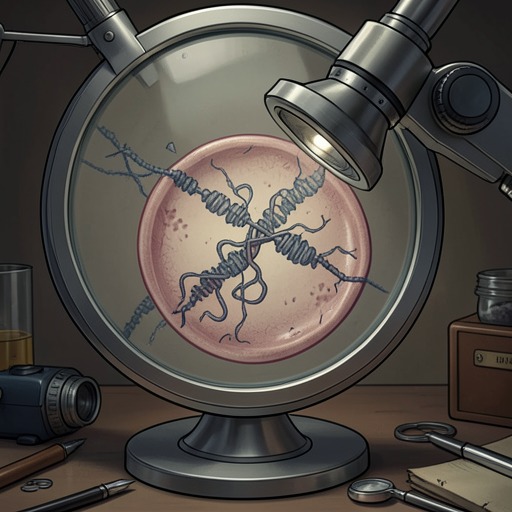
The theory is framed as a concern shared by distinguished researchers who regard agents that damage chromosomes, interfere with cell division, or cause mutations as potential causes of cancer. Investigators examining cancer tissue have found chromosomes that are unstable: they may be broken or damaged, their number may be irregular, and some cells may contain double sets. These abnormalities provide a visible counterpart to the proposed disruption of cellular control, although their presence alone does not settle the order in which the disruption and malignancy arise.
Albert Levan and John J. Biesele, working at the Sloan-Kettering Institute in New York, are identified as the first investigators to trace chromosome abnormalities through to actual malignancy. On the question of which came first, the malignancy or the chromosome disturbance, they stated that “the chromosomal irregularities precede the malignancy.” Their reported conclusion gives the theory a temporal claim: chromosomal disorder is not merely an accompaniment of established cancer, but can come earlier.
Latency and Accumulating Change
The account does not portray chromosome damage as necessarily producing an immediately recognizable cancer. Levan and Biesele suggest that after initial damage and resulting instability, a prolonged period of trial and error may extend across many cell generations. During this latent period, mutations accumulate until the cells acquire the capacity to escape control and begin unregulated multiplication. The theory therefore links an early cellular disturbance to an outcome that may remain hidden for a long time.
That delay connects the proposed mechanism to the book’s discussion of chronic exposure. It describes pesticide residues as entering the body in very small amounts, accumulating because they are stored and only slowly excreted, and posing a threat of chronic poisoning and degenerative changes in the liver and other organs. Separately, the book cautions that even a single exposure can precipitate acute poisoning if the amount is large enough, while identifying acute illness and death among heavily exposed workers and others as distinct from the larger problem it addresses. These observations establish the setting in which delayed harm is considered; they do not, by themselves, demonstrate that pesticide exposure produces the chromosome changes in the cancer theory.
Significance and Limits
The theory makes time part of the causal problem. If an initiating chromosome injury can be followed by many generations of cellular change before malignancy appears, the eventual cancer may emerge after the cause has been forgotten or is no longer suspected. The account’s emphasis on latency thus explains why the absence of immediate illness cannot, within this proposed model, establish that an exposure had no lasting effect.
The book also warns that people are not exposed to one chemical at a time: insecticides and other chemicals may interact, and Food and Drug Administration scientists reported that simultaneous administration of malathion and certain other organic phosphates could produce poisoning up to 50 times as severe as predicted by adding their separate effects. That finding concerns synergistic acute poisoning, not proof of chromosome mutation or cancer. Taken together, these discussions place the chromosome theory within a broader argument about delayed and interacting chemical hazards while preserving the distinction between observed poisoning, chromosome abnormalities in cancer tissue, and a proposed pathway from chemical damage to malignancy.